
How Do You Actually Roll Out Claude Across an Engineering Organisation?
If you want to know how you can effectively use Claude in your organisation, this article is for you.
There are a couple of different starting points and paths for rolling out Claude, and which one you take depends on what your organisation already looks like, not simply on which one sounds more "enterprise".
Keep reading to understand how to get Claude onto every desktop properly, and govern what people build with it once it's there.
The options: Anthropic direct, or via your cloud provider
Path 1: go direct. If your business doesn't already have a large committed cloud spend to protect, the fastest way in is a direct subscription (Pro or Enterprise) straight from Anthropic. Any seat count, competitive per-seat pricing, and everyone gets the same thing on day one: Claude Desktop, installed, sanctioned. Not a scatter of personal sign-ups on work laptops.
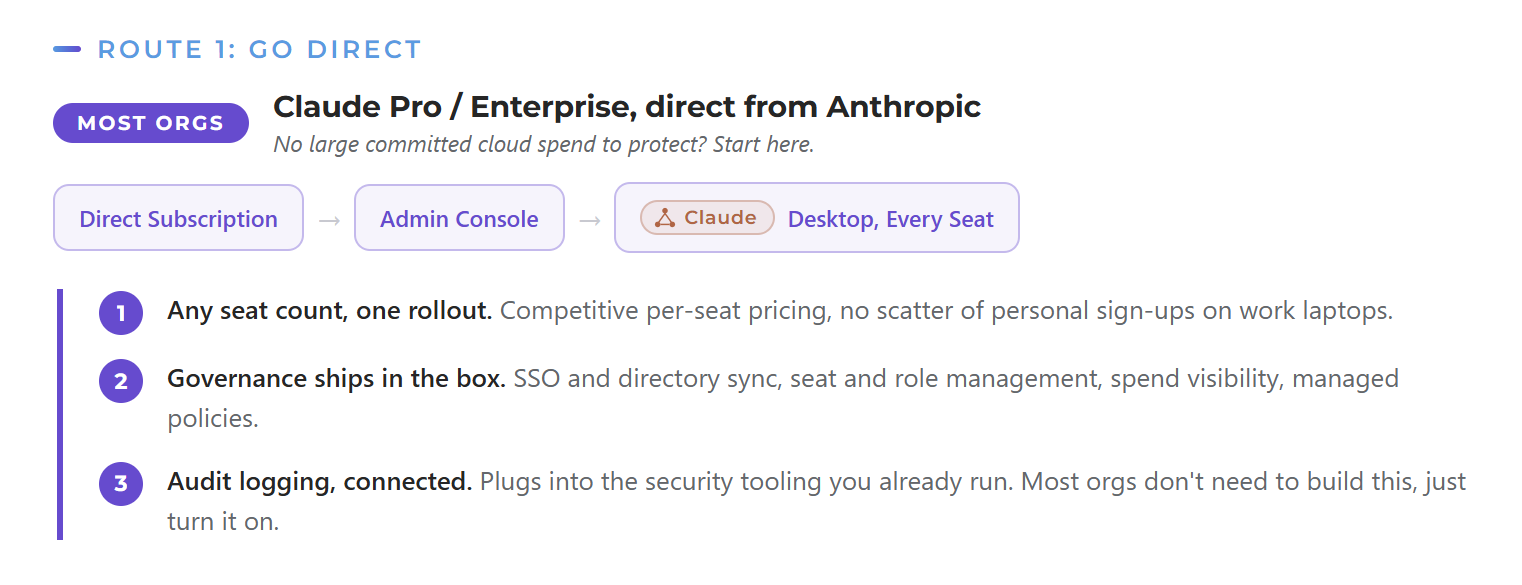
Doing it this way means everyone gets Claude Desktop right away and as an organisation you get an admin console with SSO and directory sync, seat and role management, spend visibility, managed policies, and audit logging that plugs into the security tooling you already run. Most organisations don't need to build governance here. They need to turn it on. This is by far the simplest strategy to get secure access to Claude (and take a guess who can help you with this).
There are, however, a couple of things to consider, including where you data is processed. In this instance even though it's all protected and secure, it'll be processed on Anthropic servers in the US or Sweden.
Path 2: infrastructure-first. Larger businesses already deep in Azure or AWS governance are right to route Claude through what they've built instead. Same Claude Desktop, same Cowork but a different backend. In this set-up, you subscribe to Claude models via your cloud provider, and then point Claude Desktop to the models via APIs. Two options largely exist here: Microsoft Foundry or AWS Bedrock.
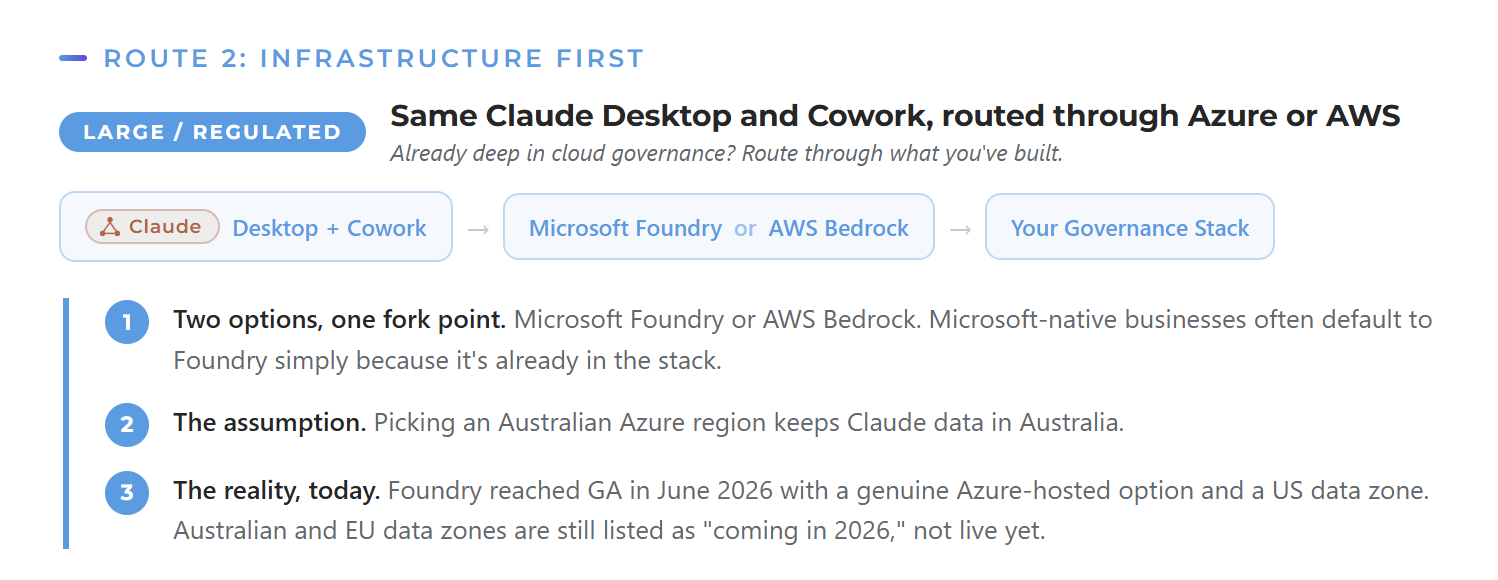
As an example, thinking your Azure subscription to the Australia region means your data stays in Australia? Not currently if you use Claude.
The assumption which costs people the most
Picking an Australian Azure region keeps Claude data in Australia.
That assumption is wrong today, and it's the one we correct most often with Microsoft-native clients. If Microsoft are telling you your data is stored within Australia, that's true, but as soon as you subscribe to Claude via Microsoft Foundry, any data that is part of a Claude action heads offshore.
Foundry reached general availability (GA) in June 2026 with a genuine Azure-hosted option and a US data zone, a real step forward, not a marketing one. But Australian and European data zones are still listed as "coming in 2026." Not live. Choose Foundry today as an Australian business and you cannot guarantee your inference stays in Australia, regardless of which Azure region you click.
AWS Bedrock is ahead here, and it's an architecture difference, not a feature gap Microsoft hasn't ticked off yet:
🟢 AWS Bedrock: Australian routing profile live since April 2026. Most Claude models (excluding Fable at the moment) can be pinned to the Sydney/Melbourne boundary, for both storage and inference. Provided you select the Australian profile specifically you get a real guarantee. The broader Asia-Pacific and global profiles don't carry it yet however.
🟡 Microsoft Foundry: Azure-hosted option and US data zone live since June 2026. Australian and EU data zones are still on the roadmap, so don't expect to have "data sovereignty" if you're accessing Claude models via Foundry.
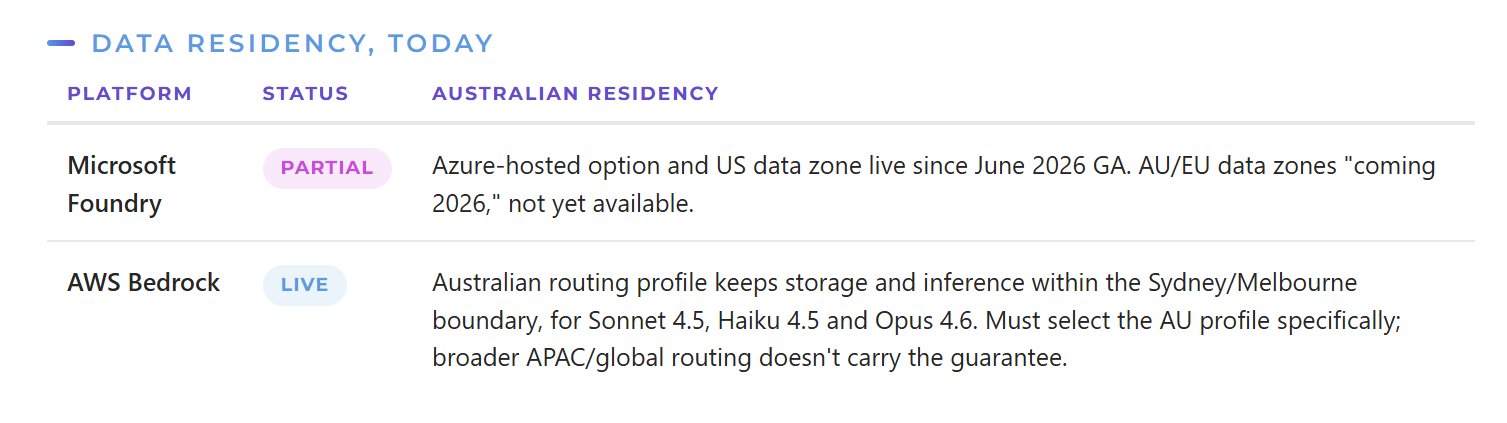
In essence, Microsoft-native for billing and identity consolidation is still a fine reason to run Claude through Azure as this is environment your ICT team already manages (costs, security, policies, etc). If you genuinely have Australian data residency as a hard requirement, today then Bedrock is the defensible path, through the same desktop experience your people already use.
Ok, so you've got access to Claude... then what?
The moment Claude (Cowork especially) lands in enough hands across an engineering business, people start building: A report-formatting skill here. An ITT-versus-proposal checker there. A connector into the project system nobody told IT about. Every one of them useful and every one of them built with good intentions, yet every one of them completely ungoverned.
If we look a mere six months on, nobody will remember who owns which tool, half of them will have quietly stopped working because a system moved on underneath them, and nobody will be able to tell you what any of it is doing with your data. This is a huge problem which unpicks the progress you thought you were getting by bringing Claude into your business. It's also about this time that questions about "value realisation" and "business resilience" will start surfacing now that AI is really starting to embed.
It's therefore super important to understand that Claude was never the risk in this. The tools nobody governed afterwards were the real risk.
Unfortunately this is the default outcome of giving a capable, agentic tool to a workforce with nowhere to put what they build.
Where Skyo Core fits
This is exactly the gap Skyo Core closes.
Skyo Core is our engineering and reporting assistant, built for the tools engineers actually need, e.g report writing, gap analyses, proposal-versus-ITT checks, presentation drafting. We build it by listening to what engineers are trying to solve, and we house it in one governed environment instead of leaving it scattered across a workforce, one tool per team, one owner who's since moved on.
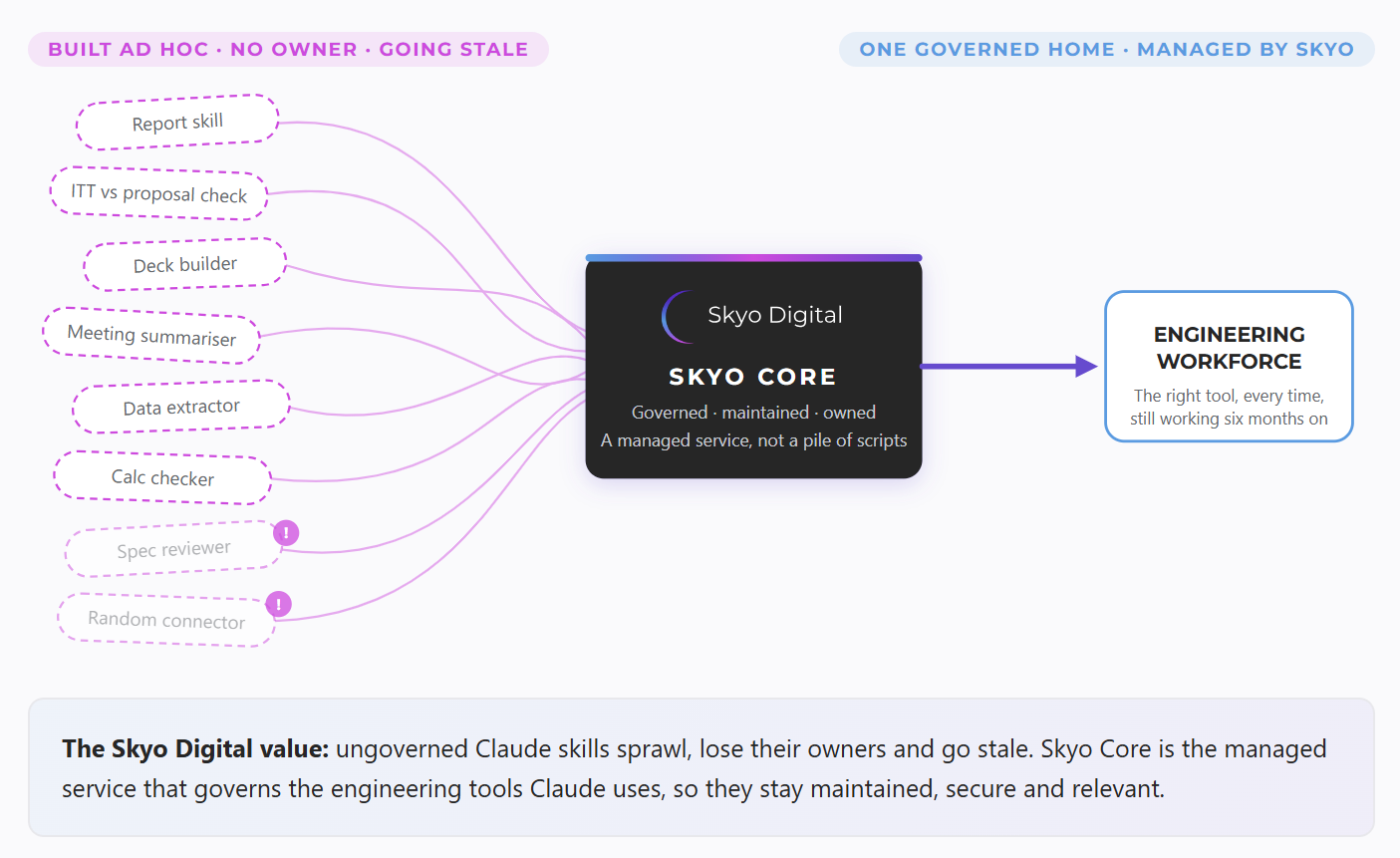
So when your organisation rolls out Claude (whichever path gets you there) Skyo Digital and Skyo Core become the contained, managed home for every technical tool your engineers rely on. We're there to help ensure the skills and tools remain maintained, secure, versioned and owned.
The takeaway
Rolling out Claude is becoming a more well-trodden part now. Governing what your organisation builds with it afterwards is where the real risk, and the real value sits.
If you're considering how to get started here, get in touch: info@skyodigital.com. We have the team and skills to ensure you get value and resilience out of deploying Claude to your organisation.
