
A case study in using Claude Code and engineering judgement to do what neither could do alone.

A client came to us with a problem that, on the surface, looked like a document-rewrite problem that AI could assist with. It ended up being an engineering-led agentic AI scope requiring mutliple skills and tools orchestrated by Claude Code.
They had a technical submission of more than 600 pages, close to 200,000 words, hundreds of figures, fifteen major disciplines. They needed to compress it to a hard 150-page limit, against a revised delivery scope and a different commercial story. Roughly a 75% reduction. Every retained passage had to earn its place and every cut had to be defensible.
A conventional team of senior engineers reading sequentially, debating, reducing and re-writing would have needed one to two months, costing anywhere upwards from $30,000.
We delivered it in two weeks, end-to-end, including the client comment cycle.
Why a human-only team would have struggled
This job required a line-by-line act of engineering judgement at scale, which naturally lends itself to an AI-assisted engineering-led workflow. Every one of the roughly 300 subsections (across process, electrical, civil, marine, environmental, commercial and governance disciplines) had to be classified into one of five actions:
🟣 Remove 🔵 Reframe 🟢 Update 🟡 Reduce ⚪ Retain
Each decision had to be defensible, traceable, and consistent with the assessment criteria and the revised programme scope. Multiply that across 300 subsections and the workload becomes roughly 1,500 reasoned engineering decisions before a single word of the new document is drafted.
A team of senior engineers reading dense technical content with that level of scrutiny manages perhaps 30 to 40 pages a day, which was the client’s immedaite indication that a non-conventional approach was required.
The differentiators: Claude Code, used by engineers
We took a position early that shaped everything that followed.
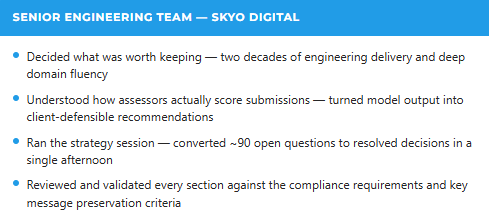
"The AI was never asked to write. It was asked to analyse, classify, and justify. The engineers decided what was worth keeping."
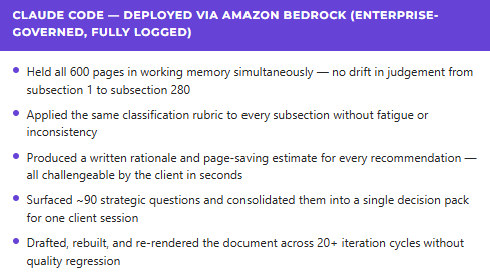
We deployed Claude Code via Amazon Bedrock. That means it’s enterprise-governed, fully logged, with the access controls a client of this scale requires. Claude Code did three things no human team can do well at this volume:
Hold the whole document in working memory. Six hundred pages, all at once, with no drift between subsection 1 and subsection 280.
Apply the same rigour, every time. No fatigue. No "section-15 quality" problem. The judgement applied to the last page was identical in rigour to the judgement applied to the first.
Justify every recommendation in writing. Each cut came with a rationale paragraph and a page-saving estimate. The client could challenge any decision in seconds.
What Claude Code could not do was know what mattered. That was something we owned. Two decades of engineering delivery, asset-class fluency, and an understanding of what really matters in a domain-specific document of this nature is what turned model output into client-defensible recommendations.
The method: a four-stage AI pipeline with human gates
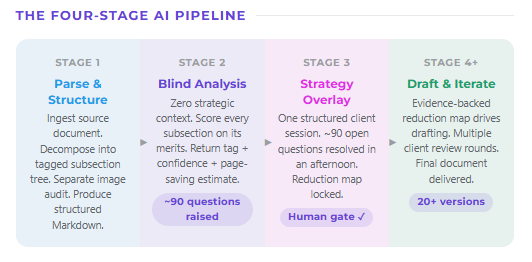
The workflow was built as a sequence of stages, each producing a client-facing report. Every stage ended with an approval gate before the next began.
Stage 1 — Parse and structure. Ingest the source document. Decompose it into a tagged subsection tree. Extract every image for a separate audit.
Stage 2 — Blind analysis. This was the breakthrough move. We instructed Claude Code to read each subsection with no strategic context whatsoever, no scope brief, no commercial framing, no awareness of which sections the client considered sacred. It scored each subsection on its merits alone, returning a Remove / Reframe / Update / Reduce / Retain tag, a confidence level (Low / Medium / High), and a conservative page-saving estimate.
The blind framing was the point. It stopped the model from rationalising weak content because it "seemed important". It produced a floor for the reduction opportunity.
🟣 Result of the blind pass: roughly 40% of the document identified as removable, conservatively, before a single strategic decision was made.
Stage 3 — Strategic overlay. Claude Code surfaced around 90 strategic questions during the blind pass, revealing the things that needed a human to decide. We bundled them into a single decision pack and ran one structured session with the client. Weeks of back-and-forth collapsed into a single afternoon.
Stage 4— Iterate. As we received client feedback we’d loop it back into the process by providing it to Claude as additional context. The result was an honed model for meeting our documentation objective.
The real power (secret stage 5)
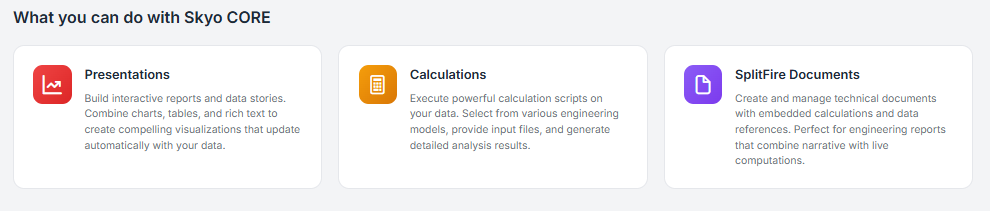
Consistent formatting across tables, sections, captions and figures is critical for high-stakes documentation. It’s also the most painful thing to get right in a heavy document. To overcome this, we used SplitFire, our AI-enabled document generation tool which automatically recombines sections of reports into consistently formatted and cross-referenced documents, removing the pain from the last minute formatting hell most document authors go through. Available in Skyo Core, we pulled it all together without the client even knowing this critical tool took care of things.
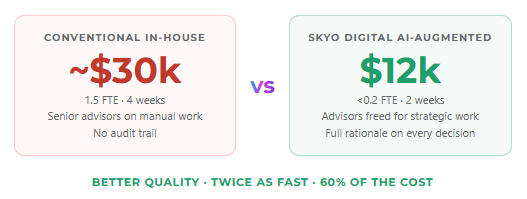
The numbers that matter
On our side of the table:
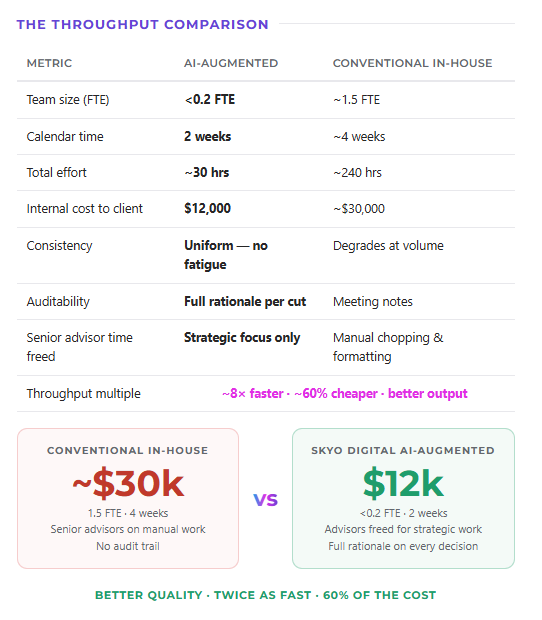
Roughly 30 hours of combined Claude Code runtime and senior engineering review, zero to final copy.
Two weeks of calendar time, end-to-end, including the client's internal comment and approval cycle.
Less than 0.2 FTE of total effort consumed and roughly $700 of tokens used.
What the client paid:
A$12,000, fixed.
What the alternative looked like for them:
A conventional, in-house effort doing the same work manually covering all the tedious chopping, re-flowing, re-formatting and consistency-checking, which would have taken roughly four weeks at 1.5 FTE.
That is six FTE-weeks of senior advisor time, compared to our 0.4 FTE-weeks, which is roughly a 15-fold reduction in the human effort required to get the document to the finish line.
More importantly: those six FTE-weeks would have come from the client's senior strategic advisors who are needed for other strategic and commercial acitivites. Instead, they spent that time on the work only they could do.
The cost saving on its own is easy to quantify. The opportunity cost it removed (senior advisors not stuck in formatting hell) was the part the client kept commenting on.
The takeaway
If you are sitting on a high-volume, high-stakes technical document problem (e.g. a tender, a regulatory response, a technical due-diligence pack, a board submission that has grown out of control) let us help get you past the frustrations, inefficiencies and opportunity cost.
Get in touch to have a conversation about the documentation issues blocking your team.
