
You spoke. We listened.
Skyo started with a simple premise: engineering teams needed a reporting solution built for how they actually work, not a general-purpose AI tool bent into shape after the fact. Since taking it to market, we have listened closely to what our clients need, and this article sets out the features we have already built in response, backed by what is running in production today.
Turning unstructured data into structured evidence
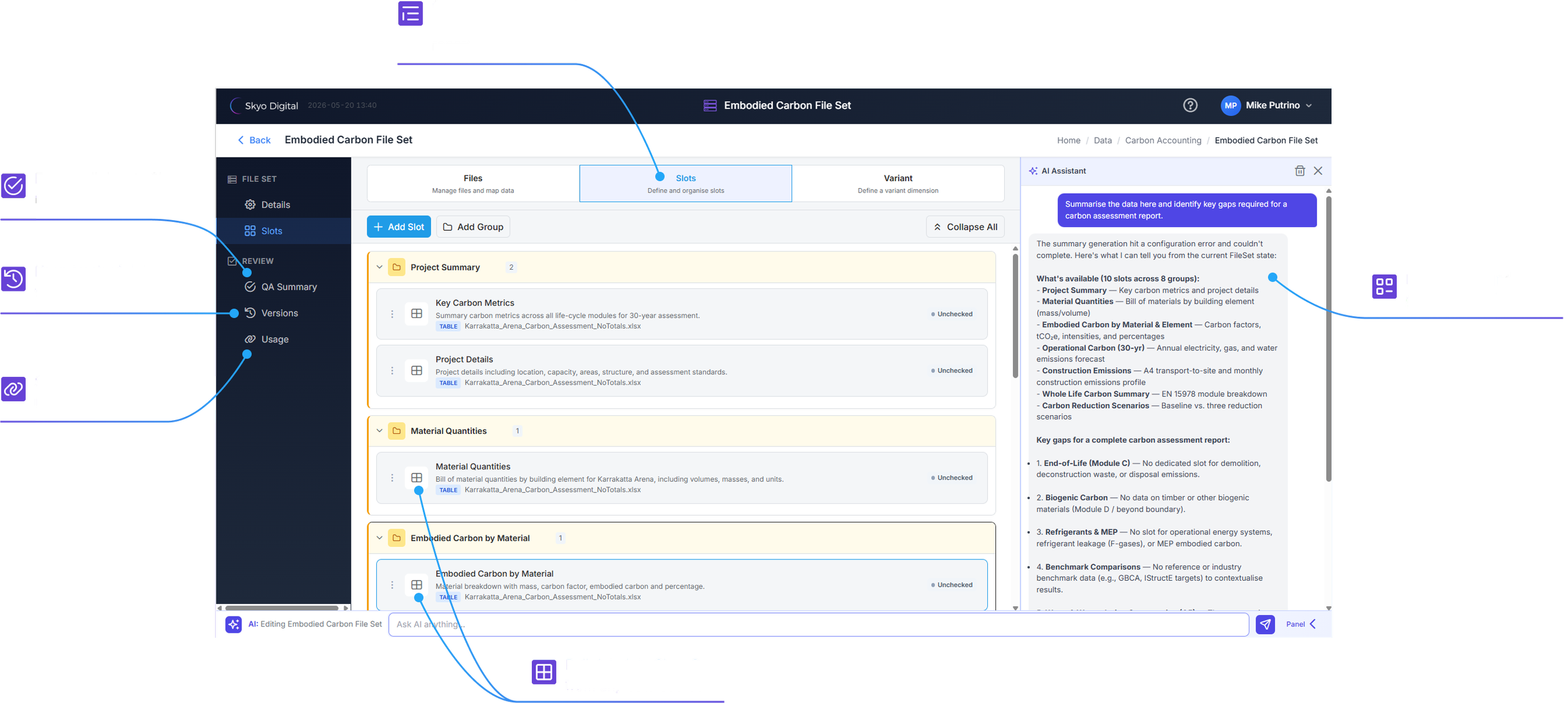
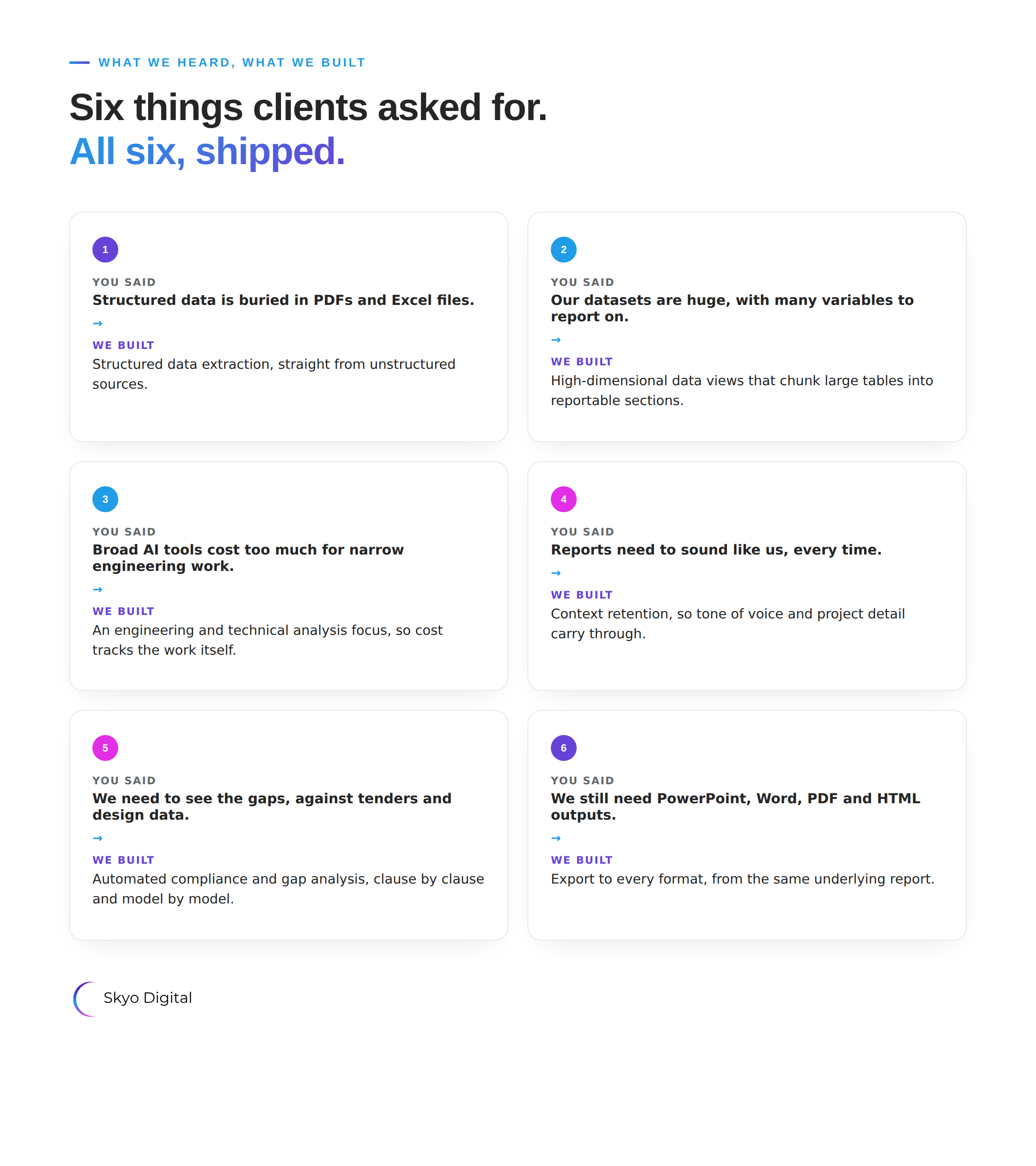
Clients told us that the biggest drag on report writing is not the writing itself, it is the time lost pulling numbers and findings out of PDFs, spreadsheets and other unstructured sources before the writing can even start. We have built structured data extraction directly into Skyo, so a project's file sets, whether that is a stack of design reports or a folder of Excel workbooks, get organised into slots and tables the platform can reason over and report against. The screenshot below shows this in practice: a live file set with its data mapped, checked and ready for the AI assistant to summarise and flag gaps automatically.
Handling scale without losing control
Engineering projects generate large tables with many variables, and clients wanted a way to bring that volume into Skyo and still produce something a reviewer could read. Our reporting engine already handles high-dimensional datasets and presents them through structured, multi-variable views, such as the parametric analysis view shown below, so an engineer can interrogate the full dataset and then chunk it into a report section by section rather than starting from a blank page.
AI that costs what engineering work costs
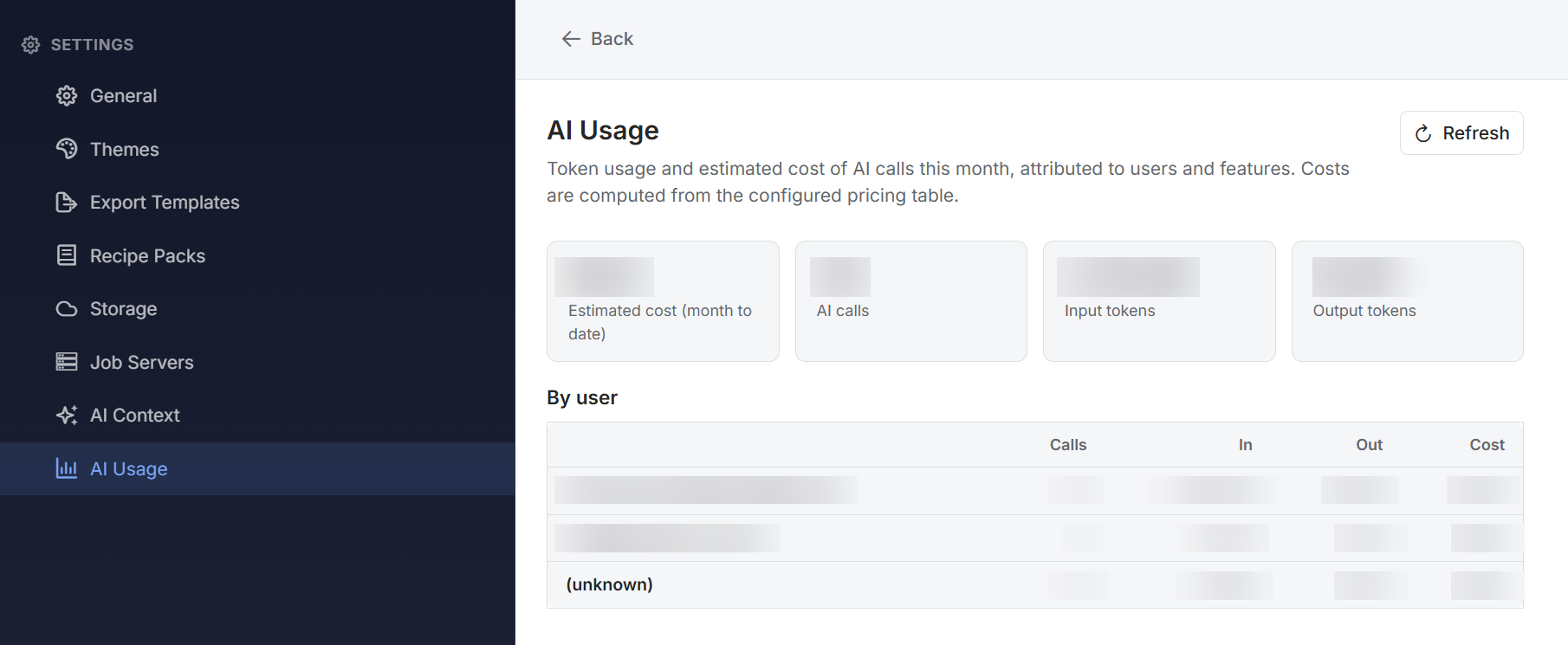
We heard a clear frustration with broad-context AI tools that charge for every token regardless of what the work actually is. Skyo is built to focus on engineering and technical analysis specifically, so the AI token cost a client pays is tied directly to engineering and technical work, not to a general-purpose assistant doing everything from drafting emails to summarising unrelated documents.
Context that matches how a client writes
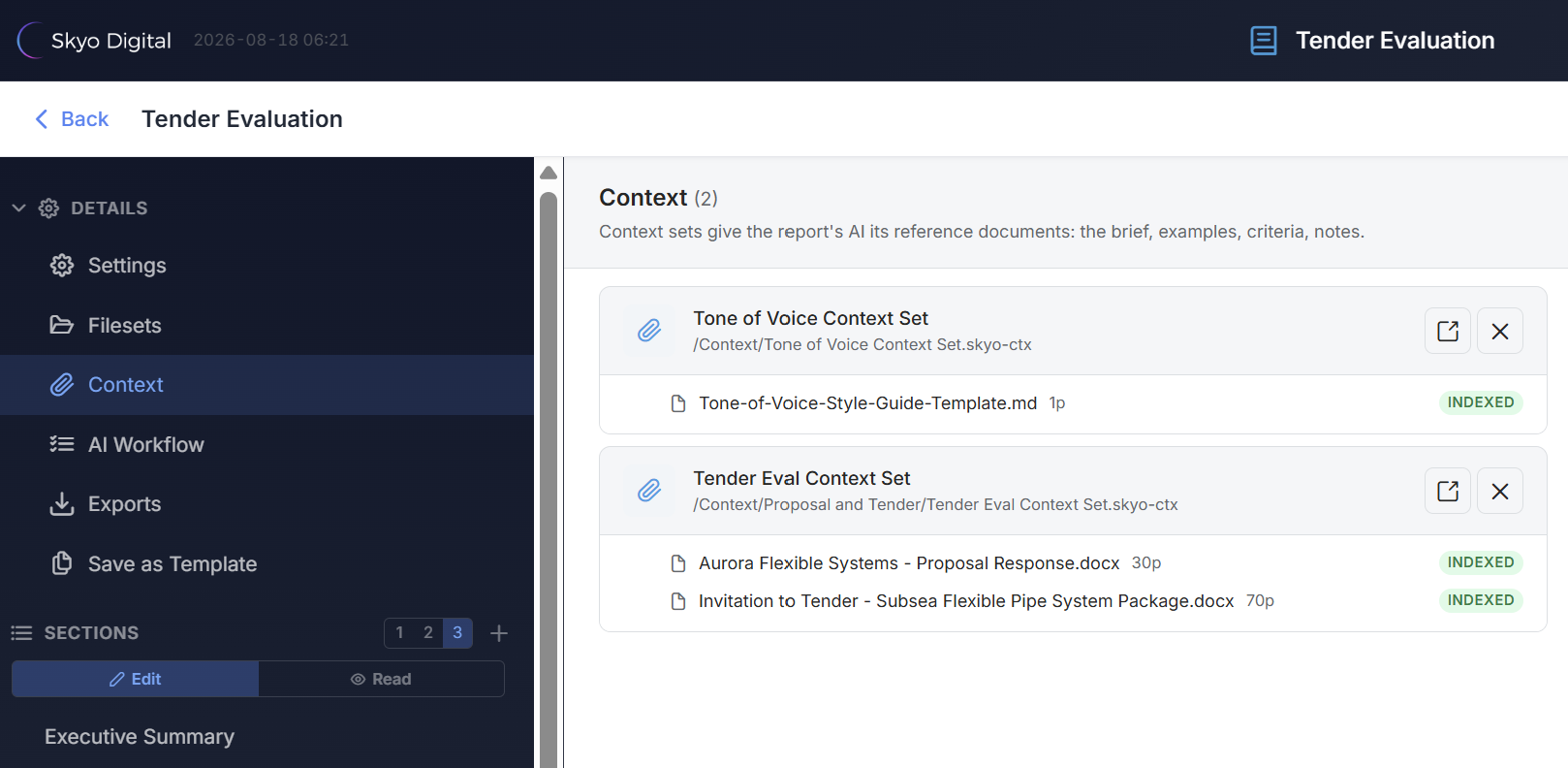
Clients also told us they needed their reports and proposals to sound like they wrote them, in their tone of voice, their format and their project-specific detail, every time. Skyo retains that context, so reports and presentations it produces adhere to a client's established way of writing rather than defaulting to a generic AI voice.
Compliance and gap analysis, built in
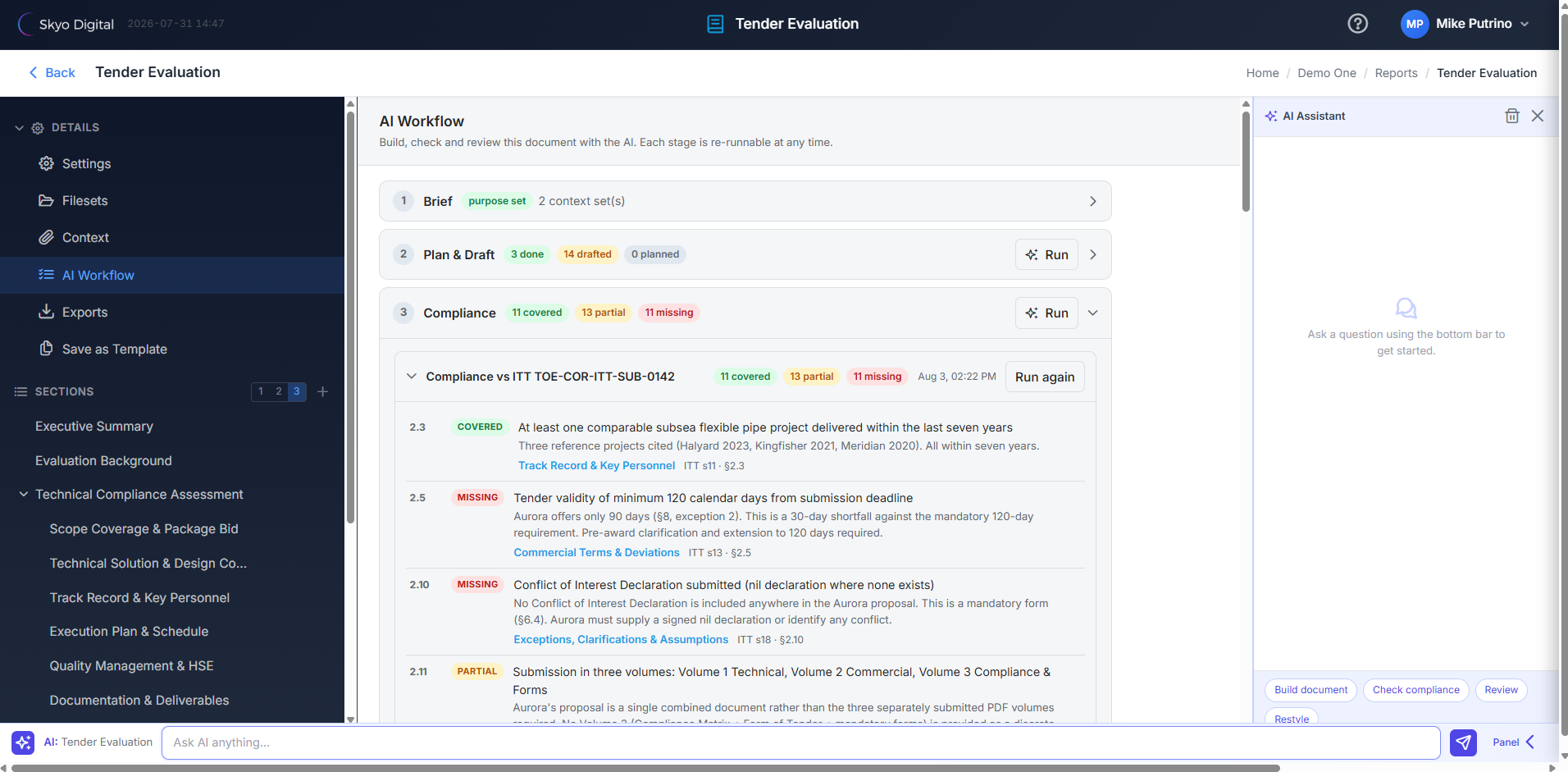
One of the most requested capabilities has been the ability to check one thing against another and see exactly where the gaps are. Skyo now runs automated compliance and gap analysis, comparing a proposal against the scope of work in an invitation to tender and flagging what is covered, partial or missing, clause by clause, as shown in the screenshot below. The same logic applies to design data held in Skyo, checking a client's simulation or design model against it and surfacing any deviation before it propagates downstream. Both checks connect directly back to the source clause or design reference, so nothing gets flagged without evidence behind it.
Export in the formats clients actually need
Digital deliverables inside Skyo are valuable, but clients still need to hand over PowerPoint, Word and PDF files, and increasingly a shareable HTML artefact as well. Skyo exports to all of these formats from the same underlying data and report, so nothing has to be rebuilt by hand for the format a client asks for.
The proof is in who is using it
We do not think features prove much on their own, so here is where they stand today. A mid-sized engineering consultancy in Malaysia is currently deploying Skyo to support their engineering design process, allowing them to increase volume without increase personnel costs. A large, multidisciplinary global engineering house is evaluating it as a reporting layer across its projects. A major subsea engineering and installation contractor is assessing it for the same purpose. A small, CAD-focused engineering firm is exploring it for its end-to-end engineering needs. Between them, that is a spread from large global engineering houses to small specialist firms, all engaging with Skyo because it solves a real, specific problem in how engineering reports get made. We are keeping these engagements unnamed out of respect for client confidentiality, and we can share screenshots and further detail directly with anyone who wants to see the evidence firsthand.
What is coming next
Listening does not stop once a feature ships, so our roadmap reflects the next round of what we have heard. We are building a desktop version of Skyo now, with simulation model QA against the design basis scoped as the next priority. Beyond that, we are working towards Model Context Protocol support so external AI tools can interface directly with Skyo's data, native Python calculation execution for engineering calculations, lightweight AI-assisted scripts engineers can generate and run without a full development cycle, direct querying and slicing of data tables for analysis and BI, and direct connections to databases such as Snowflake, Databricks and SQL sources.
Skyo was built as a reporting solution for engineering, and it stays that way because we keep building in what our clients tell us they need. If any of this sounds like a problem your team is living with, we would welcome the conversation.
Mike Putrino Managing Director & Founder, Skyo Digital michael.putrino@skyodigital.com
