
Digital Transformation in Engineering: Why Traditional IT Approaches Fail
Key Takeaways
Domain expertise is non-negotiable: Successful enterprise digital transformation in engineering requires deep understanding of operational realities that generic IT consulting cannot provide.
Domain-led digital transformation reduces costs: We show how engineering expertise, supplemented by IT expertise, improves overall cost and value of digital transformation.
Engineers must lead digital strategy: The most effective enterprise digital strategy consulting combines engineering domain knowledge with technology expertise, not the other way around.
Every engineering leader has sat through the presentation. The consultants from the big IT firm have impressive credentials, slick slides, and frameworks developed for Fortune 500 companies. They promise to revolutionise your operations through digital transformation. The price tag is substantial, but transformation is critical, so you proceed.
Twelve months later, you're facing a different reality. The implementation is over budget and behind schedule. The systems don't quite work the way your operations need them to. Your engineers are frustrated because the solutions don't reflect how work actually happens on the ground. And now you're bringing in specialists to fix what should have worked from the start.
Imagine hiring a top-tier chef with the best tools and deep theoretical knowledge of Italian cuisine… but they’ve never tasted it. They prepare what they believe is authentic. An Italian customer takes a bite and is overwhelmingly disappointed. The flavors, textures, and combinations are all wrong! Despite the chef’s credentials and impressive CV of other cuisines, the customer leaves to cook their own meal, because experience matters more than theory.
This pattern plays out repeatedly across the engineering and industrial sectors. But the problem isn't digital transformation itself. It's the fundamental mismatch between traditional IT consulting approaches and the unique requirements of engineering operations.
Why Traditional IT Consulting Falls Short in Engineering
The large IT consulting firms, EY, PwC, BCG, Deloitte and others, have built impressive businesses serving corporate clients across industries. They employ talented people and have developed sophisticated methodologies. Yet when these firms tackle enterprise digital transformation in engineering and industrial contexts, they consistently encounter the same failure modes.
The root cause is simple: engineering operations are fundamentally different from the corporate functions these firms typically serve.
Consider what makes engineering projects unique. You're dealing with physical assets in challenging environments. Safety isn't just important, it's absolutely critical. Operations happen in remote locations where connectivity is unreliable. Processes have evolved over decades to reflect hard-won lessons about what actually works in the field. Regulations are strict and non-negotiable. The consequences of failure aren't just financial, they can be catastrophic.
Traditional IT consultants approach these challenges with generic frameworks developed for finance, retail, or technology companies. They conduct workshops, create process maps, and design systems based on theoretical best practices. But theory doesn't account for the operator who needs to make decisions on an offshore platform with limited connectivity. It doesn't reflect the safety protocols that exist because someone died when they weren't followed. It doesn't understand why that "inefficient" workaround is actually critical for reliability.
The disconnect manifests in multiple ways. Systems are designed with assumptions that don't hold in industrial environments. User interfaces require connectivity that isn't available where work happens. Workflows don't accommodate the reality of shift work, emergency responses, or maintenance windows. Integration requirements overlook legacy systems that are ancient but absolutely critical.
As explored in Mike Putrino’s article on why engineers think they can do everything and why they shouldn't, there's a tension here. Engineers rightfully believe they understand their operations better than outside consultants. They're often correct. But that doesn't mean they should handle every aspect of digital strategy consulting themselves.
The Cost of Getting It Wrong
When enterprise digital strategy fails in engineering contexts, the costs compound quickly and brutally.
Direct financial costs are immediate and substantial. Large consulting firms command premium rates. A typical enterprise digital transformation engagement might run millions of dollars before a single system goes live. When the delivered solution doesn't meet operational needs, you've spent that budget without achieving the expected value. Then comes the additional cost of modifications, workarounds, or complete replacement.
Opportunity costs are even more significant. While you're struggling with an ill-fitting system, your competitors who got their digital strategy right are pulling ahead. You're devoting resources to fixing problems rather than capturing value from digital capabilities. The strategic advantages you expected from transformation remain unrealised.
Organisational costs might be the most damaging. When a major transformation fails, it creates cynicism and resistance to future change. Your best people get frustrated and leave. Trust between operations teams and leadership erodes. The organisation becomes risk-averse, avoiding necessary innovation because the last attempt went so poorly.
Operational disruption can be severe in engineering contexts. Unlike implementing a new CRM system in sales, disrupting industrial operations has immediate physical consequences. Production stops. Safety margins narrow. Maintenance gets deferred. Equipment fails. In extreme cases, people get hurt.
Here’s the common pattern emerging: A company engages a major IT consulting firm for digital transformation. The project consumes enormous resources. The delivered systems don't work as needed for actual operations. Eventually, the company brings in specialists with engineering domain knowledge to understand what went wrong and rebuild properly. By then, costs have doubled or tripled, timelines have blown out, and organisational patience is exhausted.
This isn't to say traditional IT consulting firms never succeed. They can deliver value in appropriate contexts. But in engineering and industrial environments, the risk of expensive failure is substantially higher than most organisations realise when they sign the engagement letter
Let’s take a closer look at this using an example.
An energy company is about to embark on a digital transformation journey expected to take 3+ years to revitalise systems and processes for the new digital age with the objective of finding efficiencies in production, improvements in safety and better reporting across the board. In this instance, we’re acknowledging that the fundamental business isn’t changing, and that the operators of the energy assets and industrial equipment to produce the energy are unchanging. We’ll look at a couple of scenarios here.
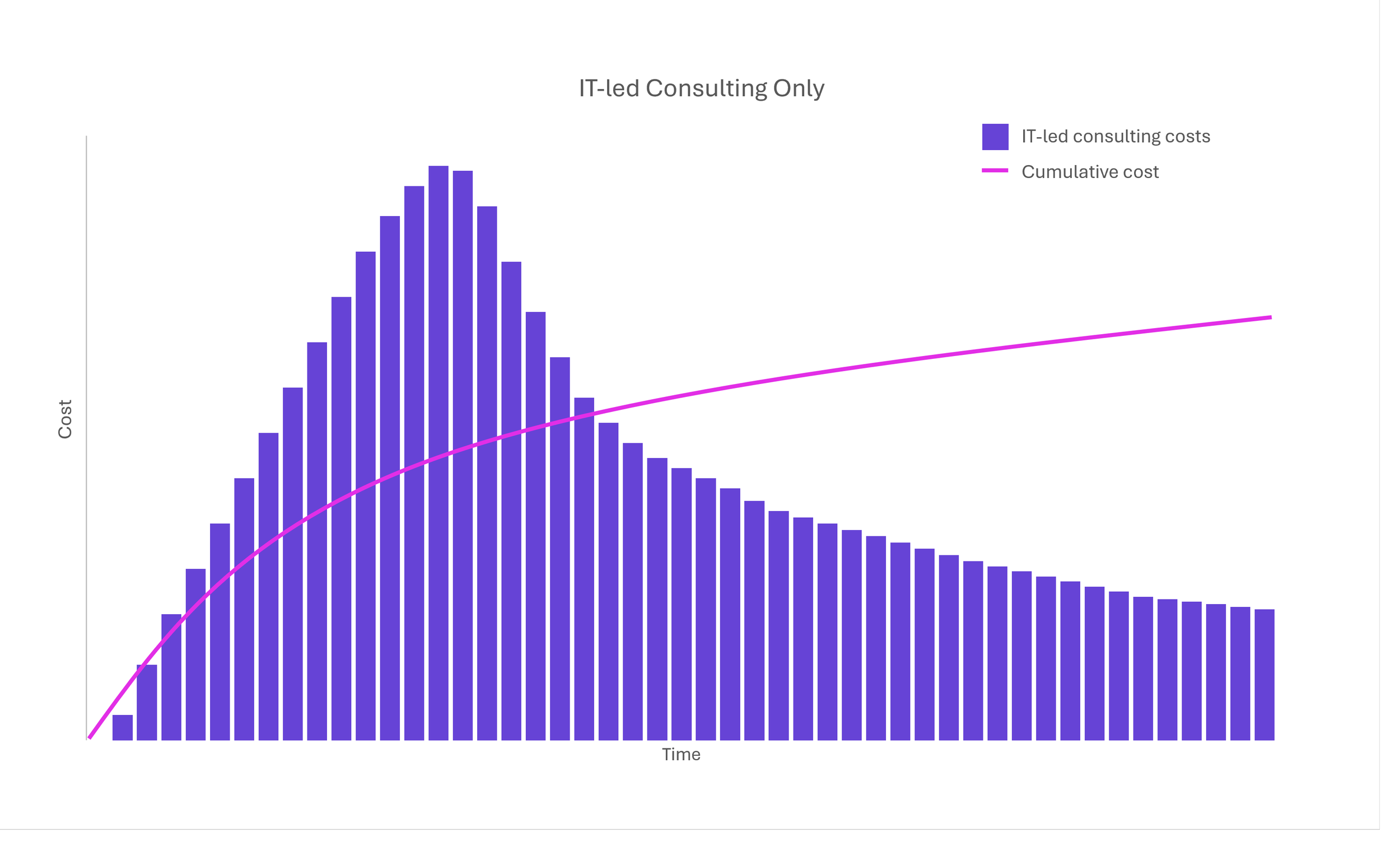
Scenario 1: IT-Led Digital Transformation
The company contracts IT consultants for the full 3+ year duration to design and implement the digitalisation journey. These consultants bring strong technical expertise to modernise systems and processes, aiming for efficiency, safety improvements, and better reporting.
Outcome: While technically sound, this approach is expensive and risks being perceived as an IT-driven initiative disconnected from the realities of energy operations.
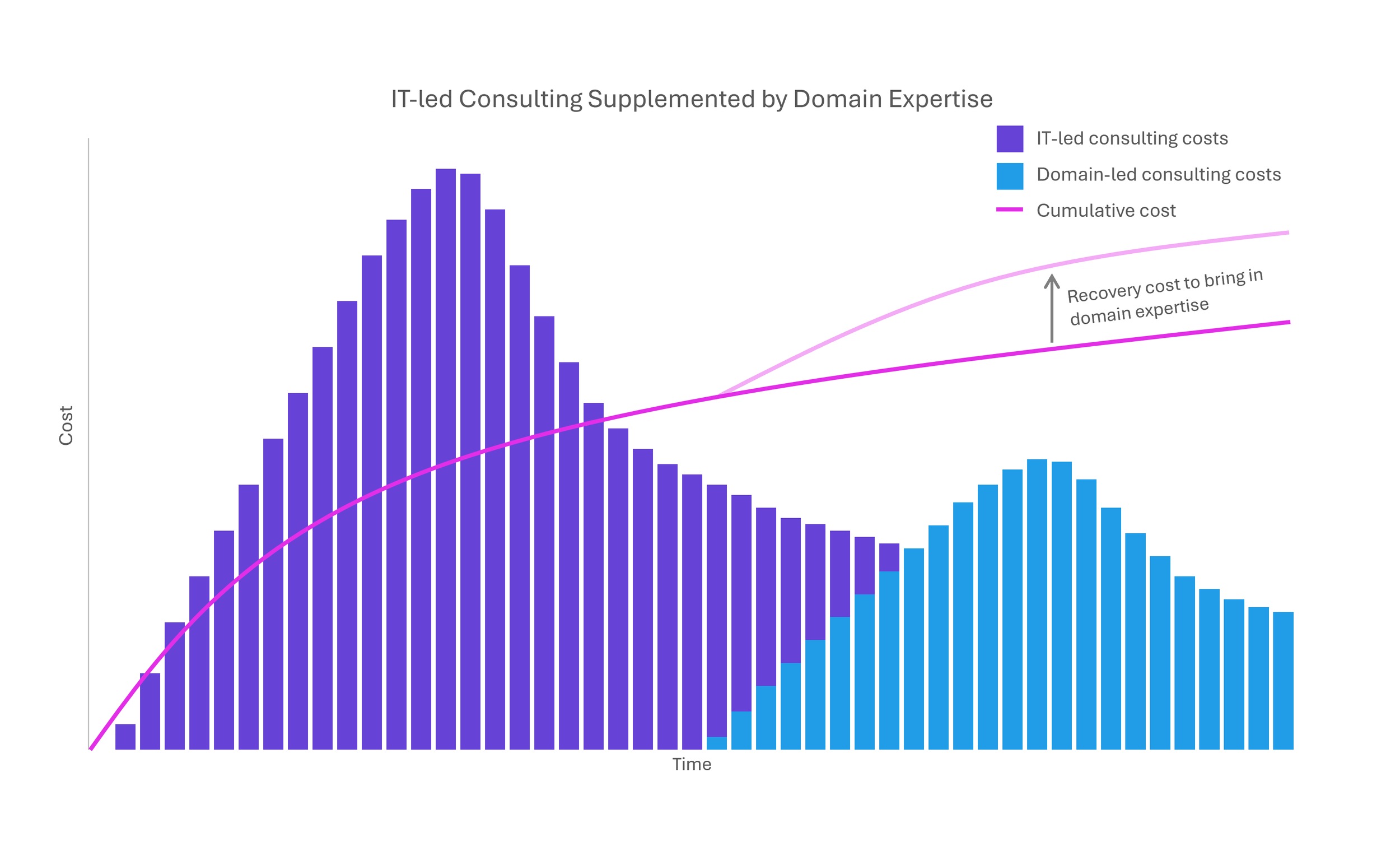
Scenario 2: IT-Led Transformation with Late Domain Intervention
After two years under Scenario 1, the company realises that operators are not engaged. They see the transformation as something imposed by IT, lacking understanding of day-to-day operations. To rescue the initiative, energy domain experts are brought in to bridge the gap.
Outcome: This scenario becomes even more costly than Scenario 1 because it adds remediation efforts and delays. It highlights the risk of ignoring operational buy-in early in the process.
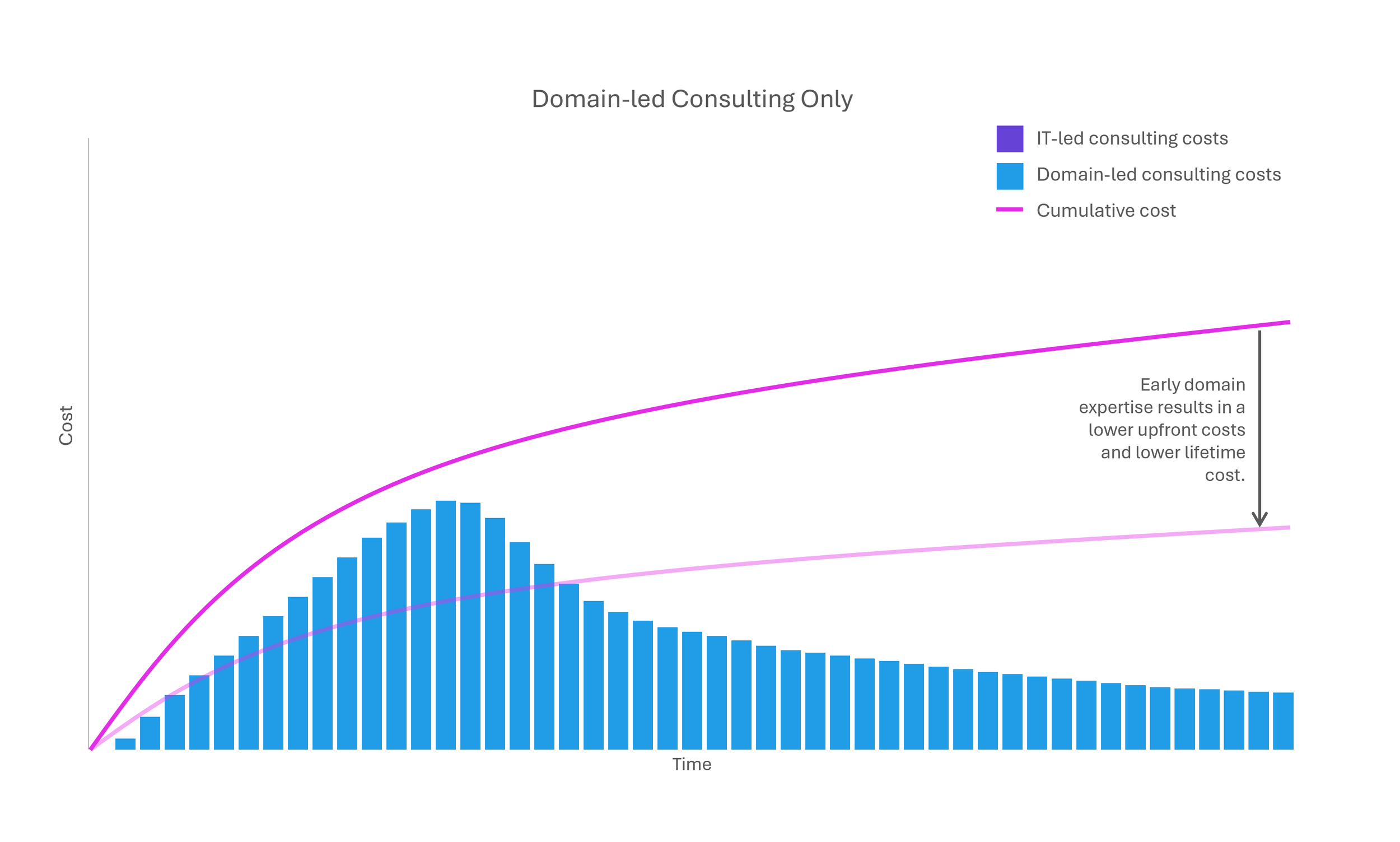
Scenario 3: Domain-Led Transformation
The company engages energy and engineering consultants with deep operational knowledge to lead the digital transformation. These experts understand the nuances of energy production and safety, ensuring solutions align with real-world practices.
Outcome: This is the lowest-cost option and ensures strong operator engagement. However, it falls short on technical execution as IT expertise is missing.
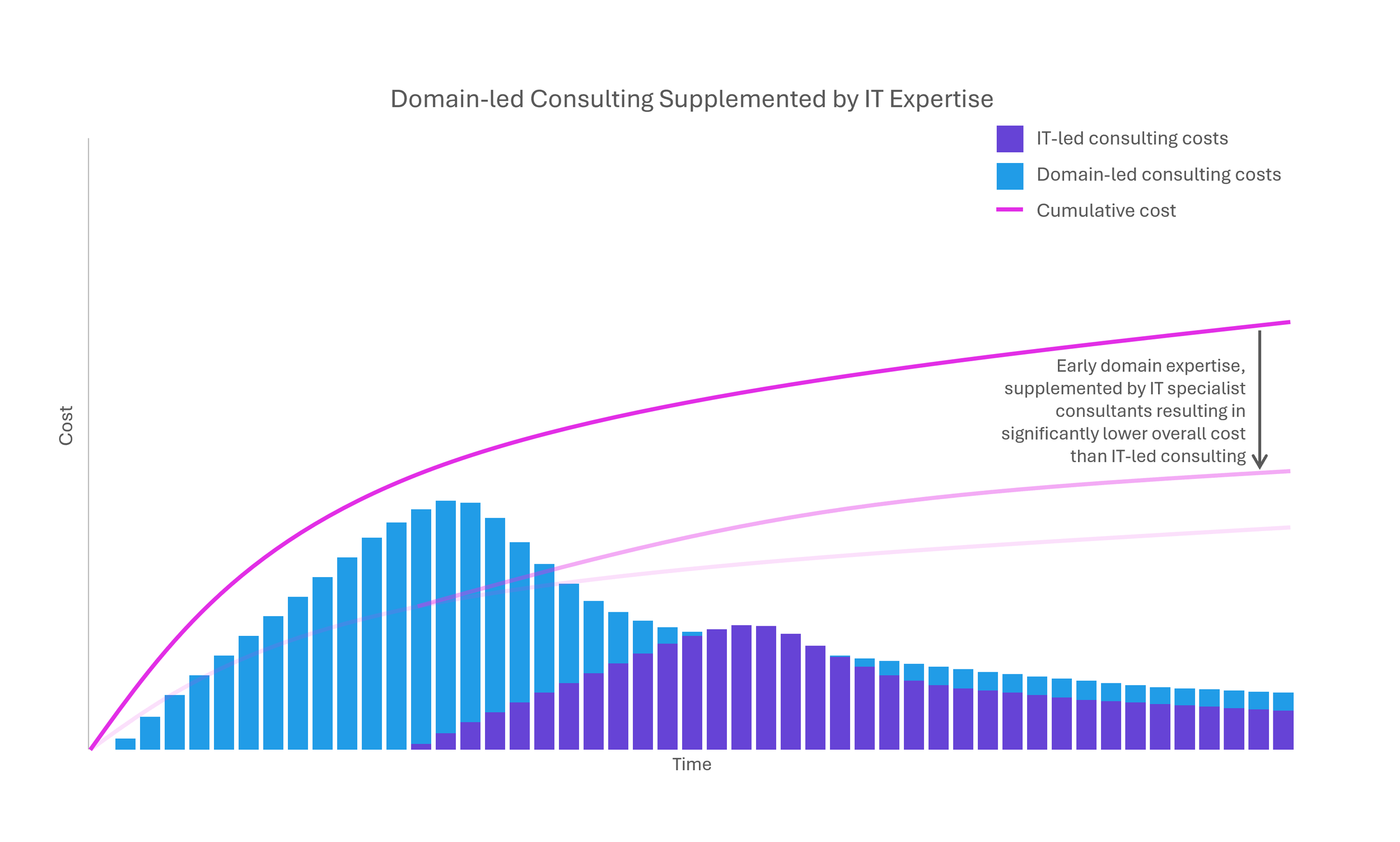
Scenario 4: Domain-Led Transformation Supplemented by IT expertise
Domain experts lead the transformation, supported by IT consultants who provide technical depth where needed. This approach combines operational insight with digital expertise, ensuring solutions are practical, efficient, and technologically robust.
Outcome: This is the second-lowest cost and the most preferred option. It delivers the best balance of domain leadership and IT support, avoiding the pitfalls of IT-driven initiatives while ensuring technical excellence.
What are we really saying here?
Scenario 4, where domain experts lead the transformation and IT consultants provide targeted support, strikes the optimal balance between investment and impact. Unlike IT-led approaches, which often incur high costs and risk misalignment with operational realities, Scenario 4 ensures that every dollar spent drives meaningful change.
From a cost perspective, this model avoids the inefficiencies of late-stage remediation seen in Scenario 2, where domain expertise is added reactively. It also mitigates the risk of underperformance associated with Scenario 3, where technical gaps can stall progress. By integrating IT expertise at the right time, but in a supporting role, Scenario 4 delivers a streamlined, proactive approach that minimises duplication, delays and rework.
The improved outcome is equally compelling. Domain-led leadership ensures that transformation initiatives are deeply based on operational knowledge, fostering buy-in from operators and aligning digital solutions with real-world workflows.
This alignment translates into safer operations, more accurate reporting and tangible efficiency gains, objectives that often remain elusive in IT-centric models. Meanwhile, IT consultants contribute the technical depth required to implement robust, scalable systems, ensuring the transformation is future-ready.
Ultimately, Scenario 4 is cost-effective and highly value-driven. It combines the strategic insight of domain experts with the technical precision of IT professionals, creating a collaborative framework that accelerates adoption and maximises return on investment. For energy companies navigating the complexities of digital transformation, this approach offers the clearest path to success. It’s a transformation that is practical, efficient and sustainable.
Building Sustainable Digital Capability
Beyond delivering specific solutions, domain-driven enterprise digital strategy consulting builds sustainable capability within the organisation. Rather than creating dependency on external consultants, the goal is to strengthen the organisation's own digital maturity.
This happens through several mechanisms:
Knowledge transfer is built into every engagement. Your team doesn't just receive a system, they understand why it was designed that way and how to evolve it. They develop capability to evaluate future digital opportunities themselves.
Technology choices prioritise solutions your organisation can maintain and extend rather than proprietary platforms that require ongoing consultant support. We help you build internal capability rather than long-term dependency.
Governance and processes are established to support ongoing digital evolution. Rather than treating each new initiative as a separate project, you develop the capability to continuously improve digital operations.
Cultural change happens through demonstrated success rather than change management programs. When people see digital solutions that actually make their work better, adoption and enthusiasm follow naturally.
Who Needs Domain-Driven Digital Strategy Consulting
Skyo Digital's approach to enterprise digital transformation serves organisations where engineering domain knowledge is critical to success:
Industrial operations in sectors like energy, mining, manufacturing, and infrastructure, where digital solutions must work in challenging physical environments and integrate with complex legacy systems.
Engineering-intensive services including construction, technical consulting, and specialised maintenance, where digital transformation must support highly skilled professionals doing complex work.
Organisations recovering from failed transformations who need specialists to understand what went wrong and rebuild properly, avoiding further expensive mistakes.
Companies planning major digital initiatives who want to avoid the traditional IT consulting pitfalls by engaging experts who understand both engineering operations and digital strategy from the start.
Choosing Your Digital Transformation Partner
The decision about how to approach enterprise digital transformation might be the most important strategic choice your organisation makes in the coming years. The difference between success and failure isn't just financial, it's existential in increasingly competitive markets.
The traditional IT consulting approach remains common because it feels safe. These firms have prestigious brands, impressive credentials, and proven track records in corporate IT. But their success in other domains doesn't translate to engineering environments. The risk of expensive failure is substantial.
Domain-driven digital strategy consulting offers a different path. It starts with deep understanding of engineering operations and builds appropriate digital solutions around operational realities. It combines engineering expertise with digital capability rather than trying to bolt operations knowledge onto generic IT frameworks.
At Skyo Digital, we've built our practice specifically for engineering and industrial organisations ready to pursue digital transformation the right way. Under Mike Putrino's leadership, our team brings the domain knowledge that ensures solutions actually work and the digital expertise that ensures they leverage modern capabilities.
We don't just deliver projects, we partner with you to build sustainable digital capability. Our approach is proven in challenging industrial environments. Our commitment is to your success, not to billable hours.
The future belongs to engineering organisations that can effectively leverage digital capabilities while respecting the domain knowledge that makes them successful. That future requires strategy advice and implementation that honours both dimensions.
Contact us to discuss how domain-driven enterprise digital strategy can deliver transformation that actually works for your organisation.
