
Digital Strategy: How to Prioritise Technology Investments for Maximum Business Impact
Key Takeaways
Two complementary frameworks: (1) effort versus success likelihood, and (2) urgency versus importance. These provide the decision-making discipline to allocate finite technology budgets strategically rather than reactively.
The effort-versus-success-likelihood framework reveals which initiatives deliver the best return on investment by combining effort cost, probability of success, strategic alignment, and expected ROI.
The urgency-versus-importance matrix exposes how much of your budget gets consumed by firefighting, enabling you to shift investment toward strategic initiatives that prevent future crises.
Positive business impact extends far beyond revenue: it includes margin expansion, competitive positioning, employee retention, customer experience, sustainability, and risk mitigation.
The gap between successful digital transformation and scattered technology spending is systematic prioritisation discipline applied consistently across your portfolio.
Your company has a technology budget. Every dollar spent on a digital initiative is a dollar not spent elsewhere. So how do you ensure that your cash is backing the right investment, and how do you prioritise those investments to ensure they’re the right ones to get after?
I’m yet to meet a business that doesn’t have this problem: too many initiatives, limited budget, and pressure from every direction. The CEO wants AI, the people want it too (well, some of them). The sales and marketing teams are convinced a new platform will transform customer engagement. Operations wants better tools and service to enable them to be more effective. Finance is asking whether the legacy system replacement is really necessary. The digital development team is itching to rebuild the technical architecture they've been complaining about.
Which of these initiatives matter? Which ones will actually move the needle on business objectives? And even more importantly, which ones are appealing projects that won't meaningfully impact the business, no matter how elegant the solution?
This is where systematic prioritisation becomes critical. Without clear frameworks, you end up funding vanity projects alongside genuine strategic investments, diluting your impact and burning through budget without proportional business returns. We need to get the vanity vs value equation right.
The Cost of Poor Prioritisation
Right now, it’s incredibly popular to chase AI projects so that businesses can claim a competitive edge, an industrial brag, or perhaps something more modest, like simply learning how to do it for a future project. However, there are potentially dozens of other projects to tackle which will have a greater positive impact on a business now and into the future. It’s important to not get carried away with vanity projects that hinder the progress of true game-changing initiatives, yet this is more common than most companies want to admit.
The difference between wasted technology investment and transformational digital strategy isn't the sophistication of the technology. It's the discipline of prioritisation.
Framework 1: Effort vs. Success Likelihood with Strategic Dimensions
The simplest prioritisation framework plots effort (cost and complexity) against likelihood of achieving intended outcomes. But this gets richer when you add three critical dimensions: alignment to business strategy, ROI expectations, and lifetime value.
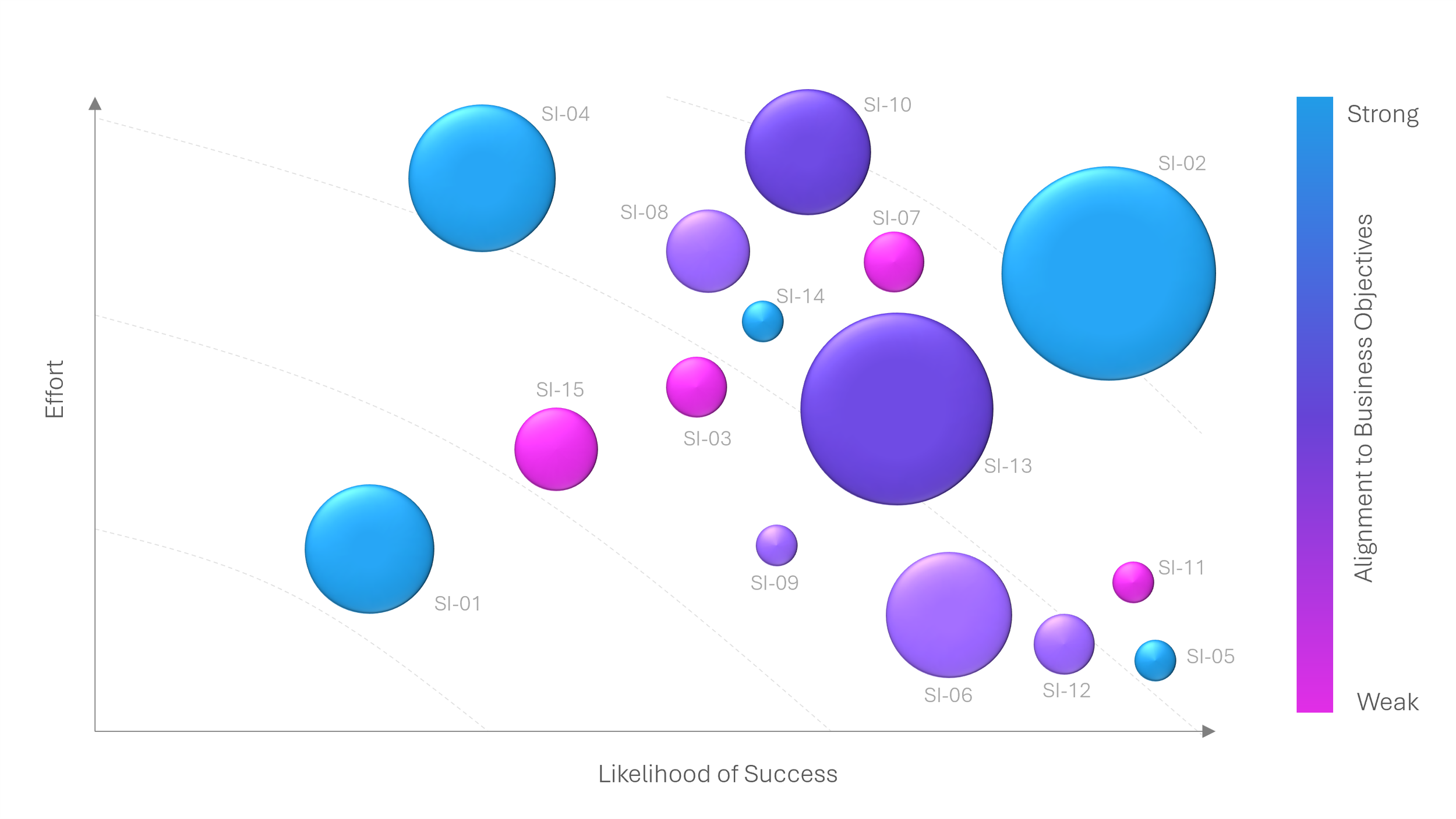
Strategic initiatives plotted against effort and likelihood of successful implementation, sized by investment cost and colour-coded by alignment to business objectives.
Start by plotting initiatives across these axes:
Low effort, high success likelihood: These are your quick wins. They're relatively inexpensive, likely to work, and deliver measurable value. Automate a manual reporting process. Integrate two systems that should be talking to each other. Implement a compliance automation that reduces administrative overhead. These fund themselves quickly and build momentum for larger initiatives.
High effort, high success likelihood: These are strategic investments. They're expensive and complex, but the probability of achieving intended outcomes is strong. A major cloud migration. Implementing an enterprise data platform. Building AI capabilities in your core business process. These require serious budget allocation and should be tied explicitly to multi-year business objectives.
Low effort, low success likelihood: Be cautious here. These feel attractive because they're not expensive, but they're bets. A proof-of-concept on emerging technology. A new tool the team thinks might help but hasn't been proven in your context. Screen these carefully as some will surprise you with value, but many will consume time and deliver nothing.
High effort, low success likelihood: These are rarely worth funding. Yes, the new architecture would be elegant. Yes, the team wants to build it. But if success is uncertain and investment is significant, other initiatives probably deserve priority. This is where you challenge assumptions most rigorously.
The magic happens when you add dimensions. Size the bubbles by investment cost. Colour-code by strategic alignment. This forces you to see not just effort and likelihood, but whether the initiative actually matters to your business strategy.
Now that you have this view, you’re able to see which investments need some work to increase the likelihood of success before you tackle them. This might mean removing blockers, assigning the right programme manager, providing more definition of the activities, improving how you rationalise the success metrics. The idea is that you want to move your key initiatives as far to the right before tackling them.
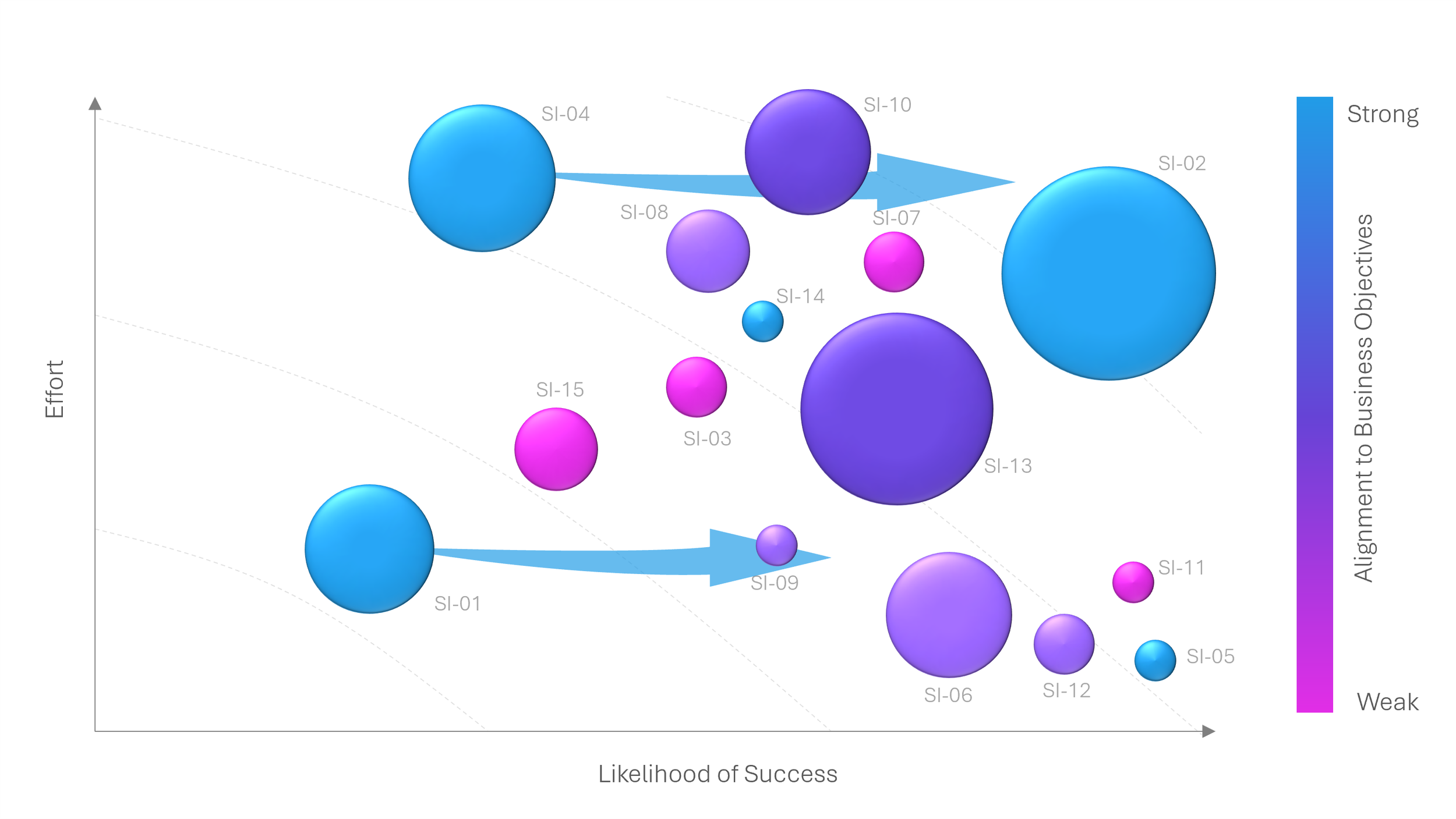
Strategic initiatives SI-04 and SI-01 should be reviewed and planned to increase the likelihood of successful implementation.
An initiative might look attractive on effort versus success likelihood, but if it doesn't align to business strategy and if it doesn't move you toward your defined objectives, it's a distraction, not an investment.
Framework 2: Urgency vs. Importance (The Eisenhower Matrix)
The Eisenhower matrix divides decision-making space into four quadrants: urgent and important, important but not urgent, urgent but not important, and neither.
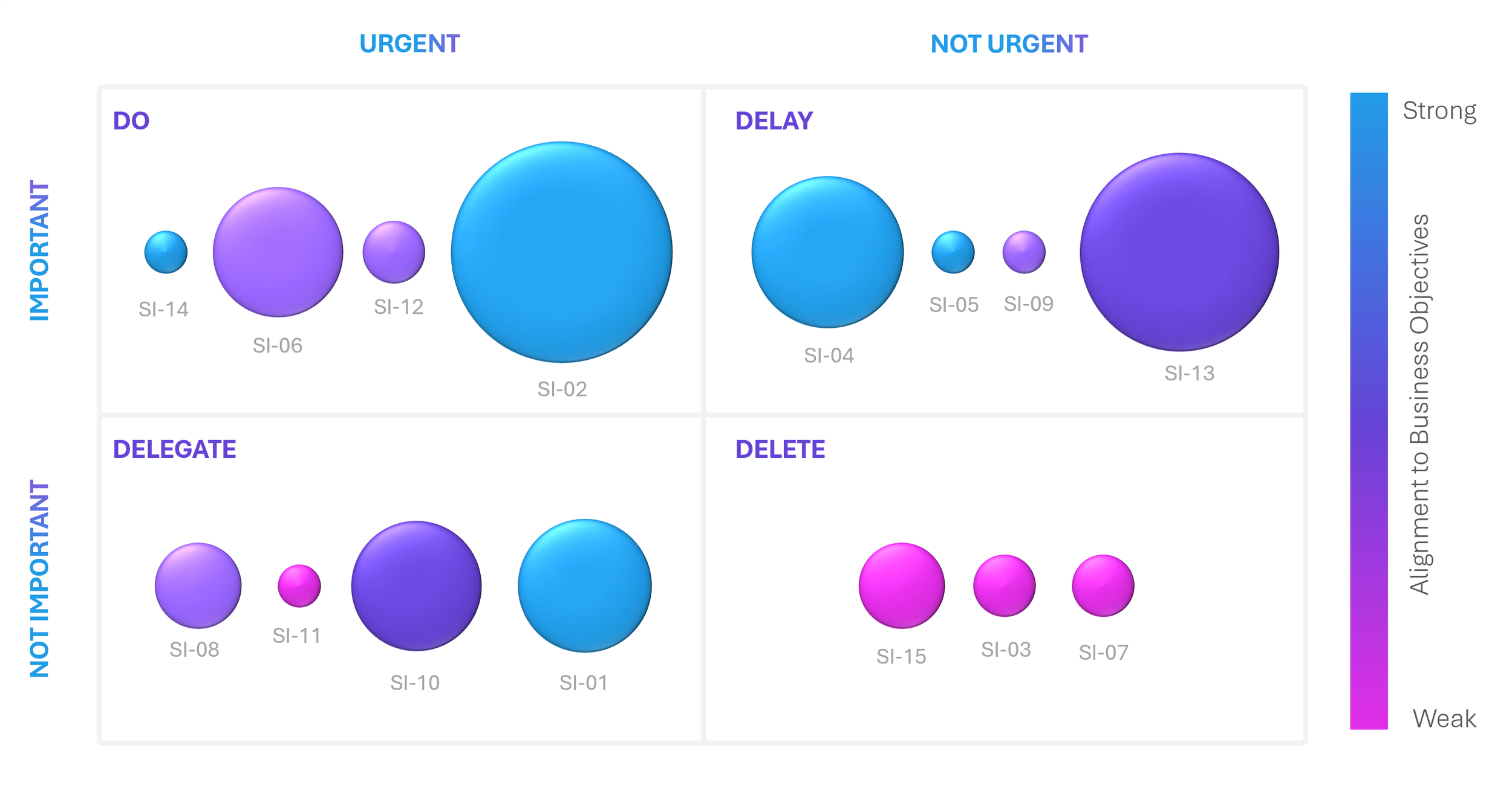
Ranking strategic initiatives in the importance vs urgency matrix, where the bubbles are sized by investment cost and colour-coded by strategic business alignment.
Applied to technology investment:
Urgent and important: Also referred to as “Do”. These include security incidents, regulatory compliance failures, system outages affecting revenue, etc. These demand immediate attention. They're non-negotiable, though ideally you prevent them through proactive investment in the "important but not urgent" quadrant.
Important but not urgent: Also referred to as “Delay”. These may include strategic technology investments that enable future business capabilities, building data governance before you have a data problem, establishing AI governance before the risks materialise, cloud migration that positions you for scale, or developing employee digital capabilities before they become a competitive disadvantage. These are where strategic thinking lives. They're easy to defer because there's no immediate pressure, but deferring them creates future crises.
Urgent but not important: Also referred to as “Delegate”. The majority of firefighting. Someone demanding a report in a format the system doesn't naturally produce. A vendor issue that needs escalation. A team member's pet project suddenly becoming a priority because of internal politics. These consume time and budget but don't move strategic objectives forward. Minimise these through better process design and clearer prioritisation discipline.
Neither urgent nor important: These shouldn't be on your roadmap at all. Yet somehow they consume resources. The "nice to have" feature nobody asked for. The tool the team wants to evaluate because it's trendy. The infrastructure rebuild that's technically interesting but strategically irrelevant. Kill these ruthlessly, hence the “Delete” label!
In our example, we’re also highlighting strategic initiatives as previous, where the bubbles are sized by investment cost and colour-coded by strategic alignment.
Most organisations over-invest in the urgent quadrants (because pressure is real) and under-invest in the important-but-not-urgent quadrant (because there's no immediate pressure). The result is constant firefighting while strategic capabilities languish.
The strategic leaders ask: "What important-but-not-urgent investments do we need to make now to avoid crises later and position ourselves competitively?"
Understanding What Counts as Business Impact
This matters because "business impact" gets used vaguely, and vague definitions enable poor prioritisation decisions.
Revenue creation: New capabilities that directly generate revenue. AI-enhanced services to customers. Digital platforms that open new market segments. Pricing intelligence systems that optimise revenue per transaction. These create measurable growth.
Margin expansion: Reducing cost per unit, automating labour-intensive processes, improving utilisation of resources, or eliminating waste. Supply chain optimisation. Automation of manual administrative work. Cloud cost optimisation. Process streamlining. These improve profitability without requiring growth.
Competitive positioning: Capabilities that differentiate you from competitors or prevent competitors from gaining advantage. Strong AI and data analytics stack. Superior customer experience capabilities. Digital-first operating model. Modern technology platform. These affect long-term market position and aren't always immediately quantifiable in short-term revenue.
Employee value proposition: Digital tools, capabilities, and work environment that make your company more attractive to talent. Modern development platforms. Flexible technology choices. Automation of repetitive work. Digital-first collaboration capabilities. These affect recruitment, retention, and employee productivity.
Customer experience: Making interaction with your business easier, faster, or more satisfying. Streamlined onboarding. Self-service capabilities. Responsive support. Personalised interactions. These reduce customer churn and increase lifetime customer value.
Sustainability and reporting: Reducing environmental impact. Improving reporting accuracy for compliance and strategic decision-making. Meeting stakeholder expectations on sustainability and social responsibility. Increasingly important for investor perception and market positioning.
Risk mitigation: Security enhancements that prevent breaches. Compliance automation that reduces regulatory risk. Disaster recovery and business continuity capabilities. Governance frameworks that prevent operational failures. These prevent costly incidents and regulatory penalties.
The key is specificity. "Improve customer experience" is a strategy. "Reduce customer onboarding time from two weeks to three days through automated verification, increasing conversion rate by 18% and reducing support cost per customer by 25%" is an investment with measurable impact.
Putting the Frameworks Together: A Decision Process
Here's how systematic prioritisation actually works in practice:
Step 1: Map using effort versus success likelihood. List all potential initiatives. Plot them across the matrix, sizing bubbles by investment magnitude, colour-coding by strategic alignment. This immediately surfaces which initiatives offer the best risk-adjusted returns. The high-effort, low-likelihood area warrants particular scrutiny, so it’s important here to challenge whether additional investigation could improve success probability or whether resources should redirect elsewhere.
Step 2: Assess urgent-versus-important positioning. For initiatives that survive step one, determine their urgency and importance. Be honest about how much budget currently flows to the urgent-but-not-important quadrant and what's driving that consumption. What systemic changes (better processes, clearer governance, improved capacity planning) would reduce firefighting? What important-but-not-urgent initiatives deserve priority to prevent future urgency?
Step 3: Align to business objectives. For each remaining initiative, answer: "Does this support defined strategic objectives? Is the expected business impact clear?" If an initiative survives technical analysis but doesn't connect to business strategy, it deserves lower priority than alternatives that do.
Step 4: Sequence based on dependencies and capacity. Some initiatives must precede others. Data governance might need to come before advanced analytics. Cloud platform selection might need to happen before migration. Identify dependencies and sequence accordingly. Assess team capacity realistically and ask whether you can successfully execute these initiatives given current resourcing and competing demands.
What emerges is a prioritised roadmap where budget flows to initiatives that combine reasonable effort-to-success ratios, strategic importance, and measurable business impact.
Discipline Creates Results (Not the Prioritisation Mechanism Alone)
These frameworks aren't complicated, but they require discipline to apply consistently. Companies often understand these concepts intellectually but abandon them under pressure. The board demands AI integration without clarity on expected business impact. A customer incident drives urgent platform changes that consume half your development team. Internal stakeholders push their priorities regardless of strategic alignment.
The organisations that successfully execute digital transformation maintain prioritisation discipline even under pressure. They ask hard questions about business impact. They say no to initiatives that don't align with strategy. They protect investment in important-but-not-urgent work even when there's no immediate crisis. They distinguish between reactive firefighting and strategic investment, and they deliberately shift the ratio toward strategy.
Digital transformation fails because companies lack prioritisation discipline, funding initiatives across the portfolio without clear strategic connection, and hoping that enough investment eventually drives results.
The alternative is knowing exactly why you're funding each initiative, how it creates business value, what trade-offs it represents, and whether it advances strategic objectives.
Ready to build systematic prioritisation discipline into your technology investment decisions?
Our fractional CTO and digital strategy services help growing companies establish clear frameworks for technology investment, align IT spending with business objectives, and create roadmaps that drive measurable business results. We work with your leadership team to evaluate initiatives, distinguish between strategic and reactive investment, and allocate capital where it creates maximum impact.
